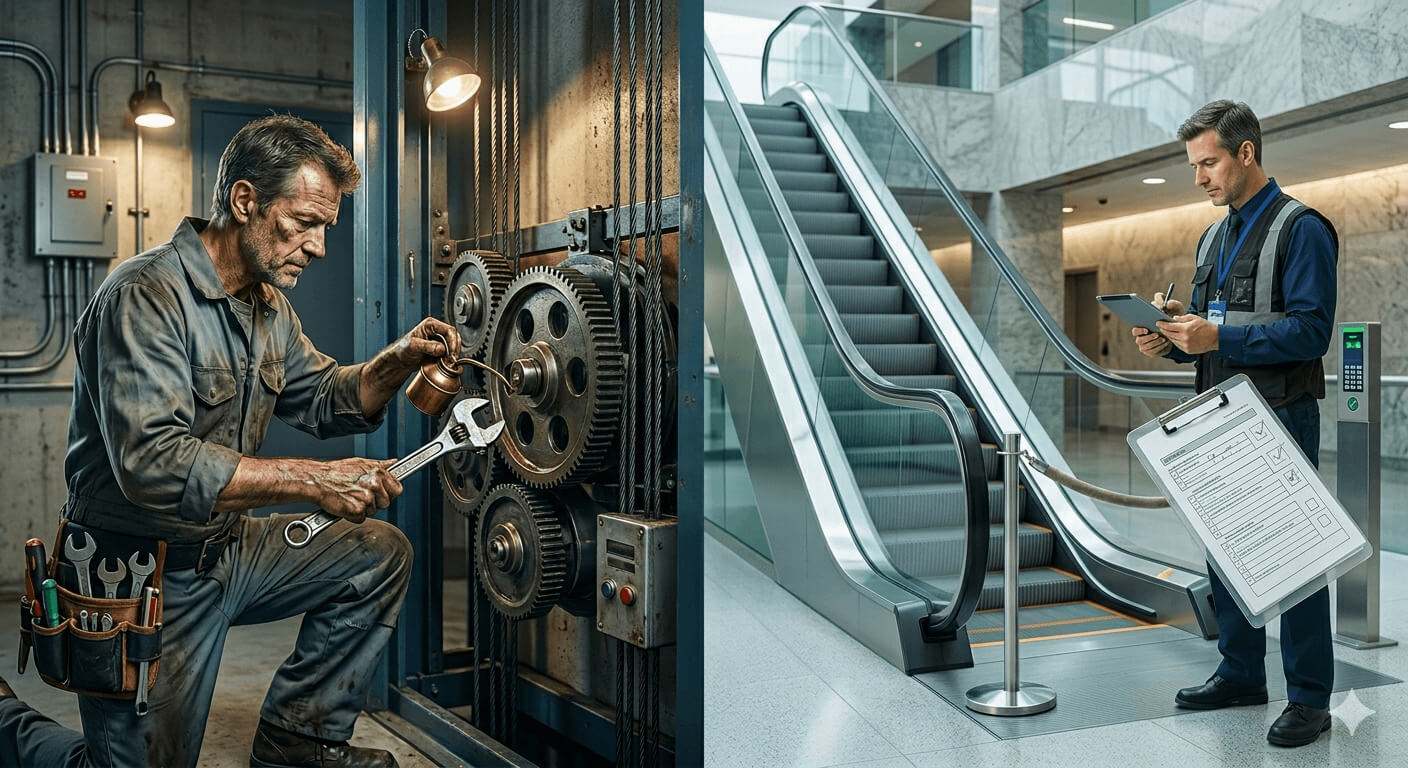
Maintenance and audit are often discussed together, but they serve very different purposes.
Maintenance is operational. It focuses on keeping equipment running smoothly through regular servicing, adjustments, and repairs. Maintenance teams respond to faults, replace worn parts, and aim to minimise downtime. Their success is often measured by reliability and response time.
An audit, by contrast, exists to verify safety and compliance objectively. Inspectors assess whether lifts and escalators meet regulatory standards, whether risks have been properly managed, and whether maintenance activities align with safety requirements. Their role is not to fix problems, but to identify them clearly and impartially.
This separation is intentional. When audit is independent of maintenance, it reduces the risk of conflicts of interest and strengthens accountability. It ensures that safety assessments are not influenced by commercial or operational considerations.
For building owners and MCSTs, understanding this distinction is critical. Maintenance inspection keeps systems operational. Audit confirms that they are safe, compliant, and defensible if questioned.
Both functions are necessary. One without the other creates blind spots. Together, they form a balanced approach to managing lifts and escalators responsibly, with safety at the centre rather than as an afterthought.
![[45] Emaan 2026 (1000 x 350 px) - 2 (1)](https://emaan.com.sg/theengineerscompass/wp-content/uploads/2026/04/45-Emaan-2026-1000-x-350-px-2-1-350x250.jpg)
![[45] Emaan 2026 (1000 x 350 px) - 4 (1)](https://emaan.com.sg/theengineerscompass/wp-content/uploads/2026/04/45-Emaan-2026-1000-x-350-px-4-1-350x250.jpg)